
Scream With Me
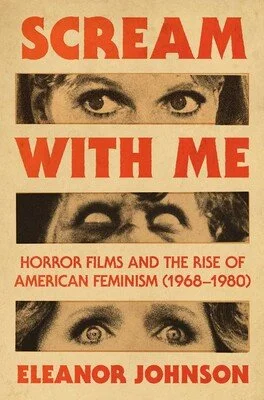
Scream With Me / Eleanor Johnson / Simon & Schuster / September 30, 2025
The notion of horror as a genre worthy of analysis and academic reverence has only emerged within the last 30-50 years. The genre, as Scream With Me argues, owes its rise to prominence in both popular consciousness and critical spheres to its unique ability to parallel the experiences of American women in the 1970s as their rights to independent lives and bodily integrity.
The book divides its analysis of film and feminism over six parts, dedicated to six seminal horror films: Rosemary’s Baby (1968), The Exorcist (1973), The Stepford Wives (1975), The Omen (1976), Alien (1979), and The Shining (1980), all of which Johnson categorizes as works of domestic horror, films that situate a female protagonist within a confined space, include a male antagonist that “cannot easily be removed,” incorporate children or reproduction into their horrific thrust, and, perhaps most importantly, were created in conversation with political upheaval surrounding women’s rights in the United States. Johnson skillfully interweaves historical fact with descriptions of the most emotionally gripping moments of distress for the female protagonists of each film. Her chapter on Rosemary’s Baby reminds readers of the legality of marital rape in all 50 states before the 1990s, and dedicates an entire subsection to Rosemary Woodhouse’s suffering at the hands of her odious husband, Guy, pinning his manipulation and psychological torment, which never escalates to direct physical abuse, as an example of coercive control. Johnson assigns language to his wrongdoing that would not have been available to viewers, nor justification for divorce in 1968 – “no-fault” divorce as a legal concept was not introduced to the United States until 1970, and would not become legal in New York, where the film is set, until 2010.
Johnson’s prose is direct and appropriately witty as she volleys with her predecessors in the study of horror cinema. In her section on Alien, she responds to Barbara Creed’s characterization of the infant Xenomorph as a “vagina dentata” with “That’s fine, to go all Freudian on it, but both the phallus and vagina readings miss the forest for the teeth.” She contributes her own theories of the foundational aspects of horror, most notably her concept of the “horror hangover,” which describes the sensation of unease that works of horror leave the audience with at their conclusion. This lingering unease is particularly relevant to stories that hinge upon a woman’s escape from a domestic space; Alien’s Lieutenant Ripley escapes the Nostromo and vanquishes the Xenomorph, but the audience is not given the comfort of knowing that she will make it back to Earth, or remain adrift in space for eternity.
I paid particular attention to Appendix A of Scream With Me: “Brief Synopses of the Terrible Remakes of the Original Six Horror Films.” Johnson briefly describes what she views as the failures of prequels and sequels that attempted to capitalize on the success of the six films in her study, most of which she attributes to an abandonment of the psychological threats of patriarchal or reproductive violence that made their predecessors compelling in favor of the more shockingly gory or supernatural. Alien, in particular, spawned a still-thriving megafranchise. While Johnson praises Aliens (1986), which positions final-girl Ellen Ripley more literally as a mother defending herself and her child against overwhelming reproductive violence, but disparages Alien 3 for its abandonment of this dynamic. As a viewer who, like many others in the age of streaming, is quick to search up and stream sequels to films I find compelling immediately after viewing them, I find the original trio of Alien sequels to be worthy of further reading as works of domestic horror (particularly Alien: Resurrection, in which the protagonist herself becomes a monsterized mother), though I am inclined to share Johnson’s distaste for some of their analogs in other series. In an era in which remakes, sequels, and re-adaptations are more abundant in mainstream cinemas than original stories, I have become wary of the potential implications of nostalgia-bait-laden installments in decades-old franchises for the future of thoughtful horror. Scream With Me, however, would argue that the era of feminist horror cinema is perhaps only now approaching its peak; its seventh chapter is entirely dedicated to domestic horror of the 2020s. The fact that the book has driven me to critically examine these sequels at all is, in my view, a sign of Scream With Me’s effectiveness in encouraging the serious analysis of horror as a means of representing patriarchal violence.
For the conscious horror fan, a screening of Alien or Rosemary’s Baby without considering the tenuous status of women’s rights 1970s is an incomplete one. It has become impossible for me to view any film outside of Johnson’s study that situates a female protagonist within a confined space with a male antagonist outside of the framework of domestic violence. Scream With Me is, hopefully, a vehicle through which conscious horror fans and writers will be made.
-Natalie Waggoner
